A Standardized Way to Evaluate Prefabrication
Part two of two: A tool for evaluating scope, cash flow, and schedule for prefabricated components
Read part one here: Your Building Is Already 48% Pre-Manufactured
A common way to describe prefab
In the first article, we introduced two metrics that indicate how much of a building is pre-manufactured and how that can impact the construction cash flow compared to conventional construction. The Pre-Manufactured Value (PMV) describes how much of a building’s hard cost is made off site. Pre-Delivery Payments (PDP) describe how much is paid before the work reaches site. Both are only useful if suppliers describe their products in a way that lets them be calculated.
Today, most suppliers describe their systems or products differently, so developers, builders, or lenders can’t compare components or judge what one will do to a project. This is why I’m proposing a standardized way to compare prefabricated components. This article and the associated tool show how such a method can help us understand the impact of Modern Methods of Construction (MMC).
What the parameters describe
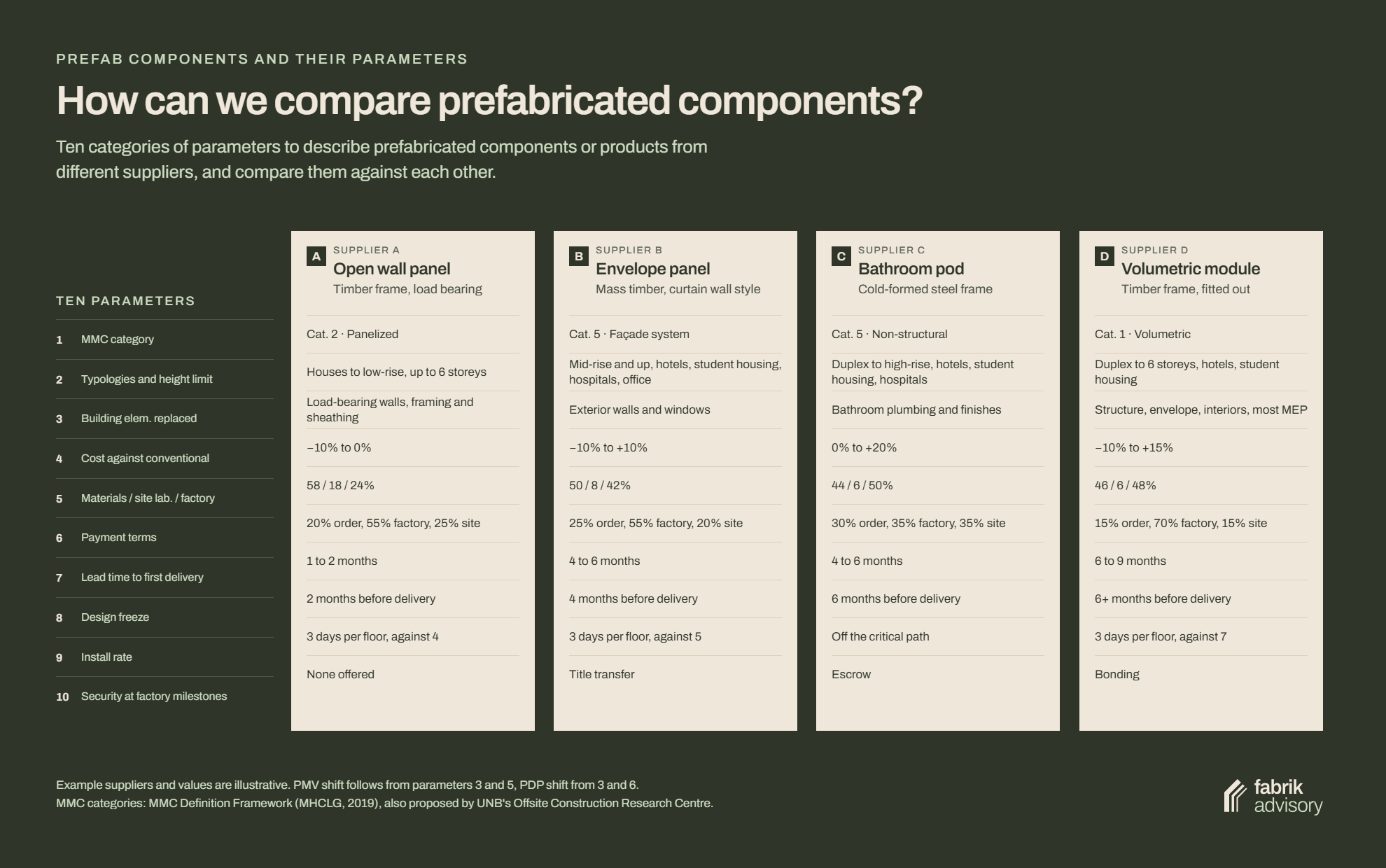
I’m proposing ten categories that describe each prefabricated component, but they come down to three major questions.
(A) Scope: which parts of a conventional building the component replaces, what share of hard cost that is, and whether it costs more or less than the conventional scope.
(B) Payment: what is paid at order, during manufacturing, and on site, and whether the supplier offers bonding or other security.
(C) Schedule: how long the lead time is, how early the design has to be frozen, and whether the component shortens the critical path.
In the end, front-loaded payments and higher construction cost will be evaluated against a potentially shorter construction schedule. A mass timber structure, for example, may cost more than a timber frame structure. That premium belongs in the comparison next to the time it saves, and the two together decide whether the component makes sense for a given project.
Tool overview
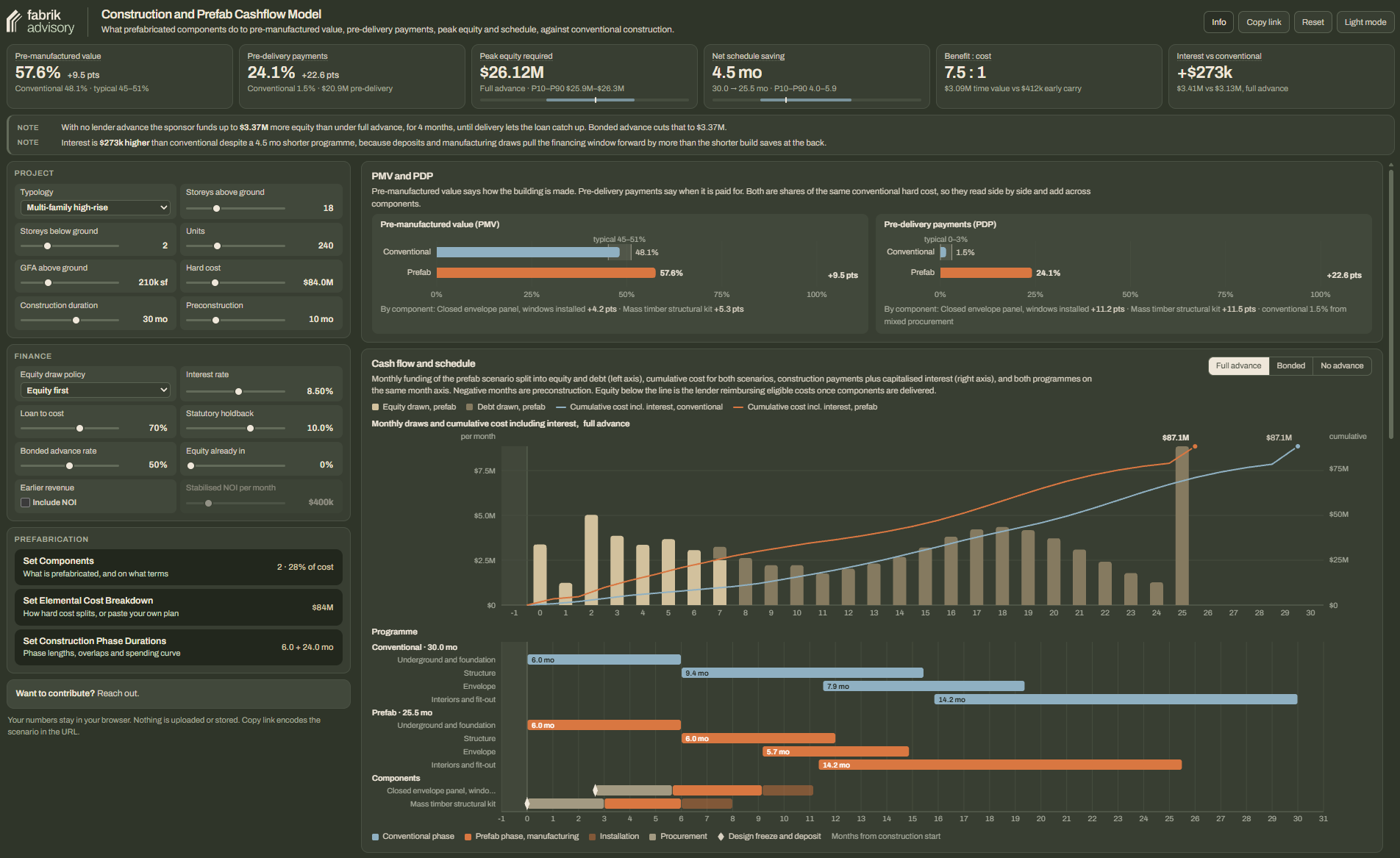
The tool opens with an example of an 18-storey multi-family building with a hard cost of $84 million and a 30-month conventional construction schedule. Two components are added: a mass timber structural kit and a closed envelope panel system with windows and cladding installed. The loan covers 70% of cost at 8.5% interest.
These are the model’s default settings when opened, but all parameters can be changed. On the left side of the tool’s interface, the project’s basic parameters can be adjusted, and different prefabricated components can be selected from a generic list of example products. Each component can also be adjusted manually to reflect different products, for example their cost or time savings.
This is where the potential value of such a tool lies: a library of real products from suppliers across North America, submitted by the companies themselves and compared within the tool.
Time and money
The schedule saving comes from shorter floor cycles. When a component cuts the days per floor, the savings are multiplied by the number of floors. Where two components work in the same phase, the slower one sets the pace, so their savings are not added.
Shorter construction lowers time-based general requirements such as site management, cranes, and hoists. It does not always lower interest. Deposits and manufacturing payments start earlier, so the loan can be drawn sooner even while the building finishes sooner.
The largest single factor is whether the lender advances against work in the factory. The model shows three cases side by side. With a full advance, the lender treats factory milestones like work on site. In the bonded case, it advances only against components secured by bonding, escrow, or title transfer. With no advance, the owner funds everything before delivery from equity.
The bonded case shows why security matters. When a supplier offers bonding, escrow, or title transfer at manufacturing milestones, a lender has something to advance against, and much of the early equity can be financed.
In the 18-storey example, the two components raise PMV from 48% to 58% and PDP from 1.5% to 24%. Construction finishes 4.5 months earlier, in 25.5 instead of 30 months. The time saved is worth about 7.5 times the cost of paying early, but total interest is still $273,000 higher than conventional, because deposits and factory payments start the loan earlier. Without a lender advance, the developer funds up to $3.4 million more equity for about four months, until delivery lets the loan catch up.
Next steps
The Construction and Prefab Cashflow Model runs these calculations for any cost plan and any combination of components. It is built for direction and ratio, not absolute dollars, and your numbers stay in your browser. I’d welcome suppliers describing their components with these parameters, so the comparisons can rest on real data. Feedback from developers, builders, and lenders on the parameters themselves is just as welcome.